High-Performing Teams Have Fur: The Cat-Dog Dynamic at Work

The difference between good teams and great teams? In my experience, it’s a little bit of dog, a little bit of cat.

Given some time and space, it’s tempting to dig deep into psychology and group dynamics to describe high-performing teams and build that perfect mix of introverts, influencers and implementers.

Given a napkin, may I present my simple fur-based diagnostic:

  • Troubled Team A? All dogs. Energetic, always chasing after goals, but not always sure what to do once they catch them.
  • Troubled Team B? All cats. Quietly perched on the window sill, evaluating those opportunities that often fly by unnoticed – from a distance.

If you’re finding your team’s goal-orientation out of whack, maybe it skews canine, or feline.

My favourite teams – and internet videos – have always been those where I can observe Cats and Dogs getting along.

In the workplace, it works best when there’s a healthy tension between action and analysis anchored on mutual Trust. (That’s a topic for another day.)

How do you know if you’re teamed with Dogs or Cats?

It comes down to that initial gut reaction – and later evaluation process – when a new project or opportunity presents itself:

  • 🐕 Dog reaction: Yes! When? Who else will be there? How are we getting there? … What’s the Opportunity?
  • 🐈 Cat reaction: What’s the Opportunity? How are we getting there? Who else will be there? When? … Yes!

To get technical for a moment: these behaviours mirror underlying cultural preferences – in the Competing Values Framework, Dogs thrive in clan or hierarchical cultures – the command and control situation, where collaboration, loyalty and structure are prized. Cats might lean into adhocracy or market cultures – where innovation, autonomy and results matter more than team process.

(And, yes, people can shift their orientation, often in times of crisis, based on Prospect Theory – risk averse and cat-like when gaining, risk-seeking and dog-like when facing loss.)

Every good, effective team needs both. The key is knowing whether you’re working with a good distribution of Dogs and Cats.

Build a culture to let both thrive.

🐕 Dog reaction: Yes! When? Who else will be there? How are we getting there? What are we gonna do?
🐈 Cat reaction: What are we gonna do? How are we getting there? Who else will be there? When? Yes!
Dogs and Cats
DOGCAT
Yes!What’s the Opportunity?
When?How are we getting there?
Who else is involved?Who else is involved?
How are we getting there?When?
… What’s the Opportunity?Yes!

HOMEWORK:
We could have a lot of fun stretching this metaphor – what do you think; does it ring true in your team? Have you worked with any Dogs or Cats lately?

When A Good Idea Goes Nowhere

When a good idea goes nowhere, it might not be the budget or the business case. It might be the culture.

You’ve done the work. You’ve spotted a real risk or opportunity. You’ve crunched the numbers, written the brief, maybe even floated it in a few meetings.

And the response? Polite nods. A couple of questions. Then… crickets.

It’s tempting to think the idea didn’t land because the story wasn’t sharp enough. Or because times are tight.

But sometimes, the problem isn’t the pitch. It’s that the people you’re pitching to live in a completely different mental model.

Take cyber security. Practitioners often see it ecologically, like tending a garden. It’s never finished. You need diversity, resilience, an understanding of the ecosystem.

Meanwhile, some execs see it as engineering, like plumbing. Install the right pipes and the water keeps flowing. Job done.

Same problem, different worlds. And if your organisation’s culture leans heavily toward engineered, hierarchical, linear thinking (the pipes), your carefully cultivated patch of strategic insight (your garden) might just wash away in the next budget cycle.

In my experience, organisations don’t fail to act because they disagree.

They often fail to act because they don’t even see the same problem.

And that’s where a lot of good ideas go to die: in the gaps between mental models, team cultures, and unspoken assumptions about what really matters.

So, if you’re hitting that weird resistance – not a no, just a slow, silent fade-out – consider :

– Who is meant to own this?
– How do they see the world?
– What language do they use when they talk about risk or investment?

It’s about meeting people where they are – understanding the frameworks they use to make sense of complexity, and translating your idea into that logic. If they think in terms of control and containment, show them how your proposal improves both. If they’re wired for risk reduction, speak to that. This isn’t manipulation, it’s navigation.

Because if your big idea lives in a different universe to the decision-makers, no amount of PowerPoint is going to get it through the wormhole.

The System Is Down

This is the first time in years I’ve experienced a ‘BSOD’ (Blue Screen of Death). I usually dismiss it as Something I Did, but I quickly realised how non-alone I was today. Much wailing, much gnashing of teeth. Dude. What.

Yep – this is one of the big ones.

So what does it all mean?

Today’s outage appears to have been caused by software from the company CrowdStrike, which many major organisations use to secure their fleets of Windows 10 (i.e. Microsoft) computers.

Security software usually needs incredibly special ‘low-level’ access to computer systems to properly protect them, so when the company issued a faulty update to the software, over the internet, automatically, it didn’t just break an application or two, it caused whole systems to crash and reboot. In some cases, the computers restarted, loaded the faulty update, and crashed again, which is why some systems are still down – it requires a human to intervene and stop the reboot loop.

It’s not an easy fix; when the humans are very distant from the physical boxes that need a swift kick. Big problems.

Is it a hack, cyber-attack or a global conspiracy?

Nah, it’s a glitch that happens all the time; but usually the effect is just an ‘unexpected error in line 10‘. Human error, without a nefarious purpose. (If it were a deliberate act, it would have been much more silent and deadly.)

Unfortunately, this is a software glitch that props up a lot of critical computers, so the real issue is the pervasive and critical nature of the software component which has broken – something called ‘csagent.sys’ is the culprit.

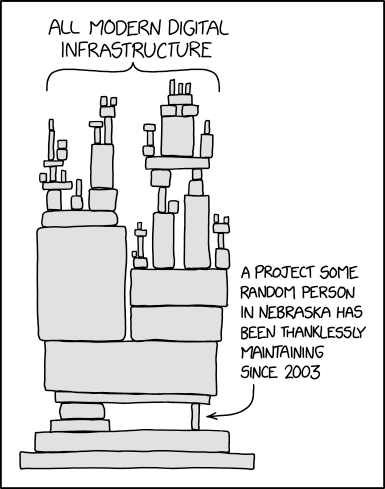
Obligatory xkcd link: https://www.xkcd.com/2347/
Substitute ‘Random Person’ with ‘Leading Security Company’

The chain of events makes it unclear whether Microsoft or CrowdStrike messed up. Microsoft was reporting issues in the morning (9:30am Aus Eastern) well before the CrowdStrike component started triggering system crashes in the afternoon (around 3pm Aus Eastern).

Observe the market’s response: the market will know – well before we will – where the blame lies.

Not Apple?

Nope. Not Apple.

Not Optus?

Nope, not Optus. Not Telstra either.

What can I do about it?

If your machine is still working, don’t worry, it’ll get sorted automatically, using the same automatic patching process that caused the problem in the first place.

If it’s not – don’t be tempted to try any of the fixes you see online or uninstalling the software; that might open you up to further problems down the track – opening windows that hackers can crawl into once the dust has settled. And don’t trust anyone jumping out of the shadows to offer you help; scammers LOVE the uncertainty created by upheavals like this and will try to confuse people into their traps.

Get in touch with your IT department or local expert, and expect a little wait.

Analogue Generative Artificial Intelligence

I haven’t seen this done, yet, but a brilliant introduction to the concept of generative AI is the well-known improv game One Word At A Time.

The idea of the game is simple, a team tells a story one word at a time. That’s it.

Which is roughly what Large Language Models are doing; just on a grander scale and with some secret sanity simulations built in.

In a group setting, try it. Give a team a prompt and see how easy it is to get close to a coherent answer.

It’s T-Time!

After an extra-long weekend I’m excited to be joining the Telstra Field Marketing team this week – and especially thrilled to be back working my home patch.

I’ll be supporting the Telstra Enterprise business in WA and looking forward to working with a new set of colleagues and technologies to help build a brilliant connected future for the West.

Let me know if you have opinions on what that future should look like ;-)

Hello Tomorrow

Bundling up my access key and laptop for shipping back to head office, it’s hard not to feel nostalgic. Back in 1998, Day One, I was given an access key, pointed toward a shiny new Pentium II desktop, and asked to ‘build websites’. No laptop back then. (No cellphones, either, only The Sales Guys got Nokia 5110s.)

Wordnerds know that nost-algia means ‘homesickness’, or the bittersweet pain or longing associated with remembering a past home.

I’ve had several homes within CA – from the earliest days as part of the crack ‘Internet Solutions Group’ at Platinum; to Product Management at Computer Associates; to Field Marketing at CA; Marketing Operations at CA Technologies; and finally, Mainframe Marketing at CA Technologies: a Broadcom Company. CA: Change, Always.

If you’ve been part of those teams, you’ll know that CA had its own way of doing things, for better or worse, and the CA Family was always ‘assuming positive intent’ and built some amazing tech and experiences through sheer esprit de corps. I’m proud to have built those with y’all – and yes, it is kinda bittersweet to know that the CA we knew is no more. (Here are some videos if you want to share that feeling now.)

I’m moving out of Broadcom, but not moving on – there are still robots and humans that need me to broker peace-among-worlds! I don’t yet have an access key for a new home, but I know I’ll always cherish my CA ancestry, wherever in the world I find my folk.

Hope to see you again soon; maybe for breakfast?